
What is the standard kitchen counter height? The standard kitchen counter height is 36 inches from the floor to the top of the countertop. This measurement is widely adopted across the industry to ensure a comfortable and functional workspace for the majority of people. However, “standard” doesn’t always mean “best for you.” The ideal kitchen counter height is a deeply personal decision, influenced by your own height, the tasks you perform, and your specific needs. Let’s dive into the world of kitchen counter dimensions to help you find your perfect fit.
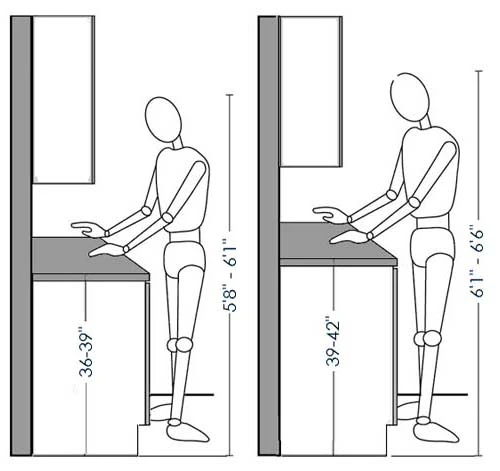
Image Source: www.regattaexports.com
The Foundations of Kitchen Counter Dimensions
When we talk about kitchen counters, several key measurements come into play. These aren’t just arbitrary numbers; they are the result of decades of design, ergonomics, and practicality.
Standard Counter Height: The Industry Benchmark
As mentioned, the standard counter height is 36 inches. This figure has become the universal default for cabinetry and countertops. It’s designed to accommodate a wide range of users for general kitchen tasks like chopping vegetables, mixing ingredients, and washing dishes. This height allows most adults to stand comfortably without excessive bending or reaching.
Average Counter Height: Reflecting Common Usage
The average counter height is, therefore, also 36 inches, as it reflects the most common measurement found in homes and professional kitchens. When you purchase pre-fabricated cabinets, they are almost universally designed to result in a 36-inch finished counter height when a standard countertop is installed.
Countertop Depth: More Than Just a Measurement
Beyond height, countertop depth is another crucial aspect. Standard countertop depth is typically 25 inches. This depth is measured from the front edge of the countertop to the wall or the back of the cabinets. This provides ample space for:
- Appliance Placement: Accommodating standard-sized appliances like microwaves, toasters, and coffee makers without them encroaching on your primary prep area.
- Working Space: Allowing enough room to chop, mix, and prepare food comfortably.
- Cabinet Access: Ensuring easy access to cabinet interiors and hardware.
A shallower depth might feel cramped, while a significantly deeper one could make it difficult to reach items stored in the back of your cabinets or even the wall behind the counter.
Counter Width: Designing for Flow
While not a fixed measurement, counter width is critical for kitchen layout and functionality. It refers to the length of the countertop. This varies greatly depending on the kitchen’s size and design. A well-planned kitchen considers counter width to create:
- Zoning: Designating areas for specific tasks, like a baking zone or a prep zone.
- Traffic Flow: Ensuring clear pathways for movement between appliances and different areas of the kitchen.
- Storage Integration: Maximizing the number of cabinets and drawers that can be fitted along the counter.
Why Does Kitchen Counter Height Matter So Much?
The seemingly simple measurement of kitchen counter height has a profound impact on your daily life in the kitchen. It directly affects your comfort, efficiency, and even your safety.
Ergonomics and Comfort: The Key to a Happy Kitchen
An ergonomic counter height is one that minimizes strain on your body. If your counters are too high, you’ll find yourself hunching over, leading to back and shoulder pain. If they are too low, you’ll be bending excessively, causing strain on your knees and lower back.
- Ideal Elbow Angle: The most ergonomic height allows your elbows to be bent at roughly a 90-degree angle when you are standing upright with your arms relaxed at your sides. This position is ideal for most food preparation tasks.
- Reduced Fatigue: Working at the correct height reduces muscle fatigue, allowing you to spend more time enjoying cooking and less time feeling discomfort.
- Injury Prevention: Chronic strain from working at the wrong height can lead to long-term musculoskeletal issues.
Task-Specific Heights: Optimizing Your Workflow
Not all kitchen tasks are created equal, and sometimes, different heights can be beneficial for specific activities.
- Chopping and Prep: The standard 36-inch height is generally good for chopping and general prep.
- Baking: For tasks that involve extensive kneading or rolling dough, a slightly lower counter can be more comfortable, allowing you to use your body weight more effectively.
- Standing and Working: For prolonged standing tasks, ensuring the height is perfect for you is paramount.
Customizing Your Kitchen Counter Height: Who Benefits?
While 36 inches works for many, it’s not a one-size-fits-all solution. Several groups of people can significantly benefit from custom counter heights.
For the Shorter Individual
If you are shorter than average, a standard 36-inch counter might feel too high. This can lead to awkward posture, the need to stretch, and general discomfort during meal preparation.
- Recommended Height: For individuals under 5’4″, reducing the counter height by 1-3 inches (to 33-35 inches) can make a significant difference in comfort and usability.
- Impact on Appliances: Remember that lowering the counter height may also require adjusting the height of your dishwasher or other under-counter appliances.
For the Taller Individual
Conversely, taller individuals might find a 36-inch counter too low, forcing them to bend excessively.
- Recommended Height: For those over 5’10”, increasing the counter height by 2-4 inches (to 38-40 inches) can create a more comfortable workspace height.
- Impact on Cabinetry: Taller counter heights are often achieved by using taller base cabinets or adding a thicker countertop material.
ADA Counter Height: Inclusivity in Design
The Americans with Disabilities Act (ADA) provides guidelines for accessible design, which include recommendations for kitchen counters. These are particularly important for individuals with mobility impairments or those who use wheelchairs.
- Clear Floor Space: The ADA specifies clear floor space in front of the counter, typically 30 inches by 48 inches.
- Clearance Underneath: For accessible counters, there must be a knee and toe clearance. The typical ADA counter height specification often refers to a lower counter, often around 30-34 inches high, with a minimum of 27 inches of clear knee space from the floor.
- Sink and Cooktop Considerations: Specific requirements also apply to sinks and cooktops to ensure they are accessible and safe.
Beyond the Standard: Exploring Variations
The beauty of a custom kitchen is the ability to tailor every element to your needs. This includes exploring variations in counter height for different zones or specific features.
Kitchen Island Height: A Central Hub’s Needs
Kitchen islands often serve multiple purposes, including casual dining, food preparation, and storage. This can influence the ideal kitchen island height.
- Integrated Work Surface: If the island primarily functions as an extension of your main counter space, a 36-inch height is common.
- Breakfast Bar Integration: When an island incorporates a breakfast bar height, it often includes an overhang. This overhang necessitates a different height to allow for comfortable seating. Standard breakfast bar heights are often around 40-42 inches, allowing for legroom and comfortable eating.
- Multi-Level Designs: Some islands feature multi-level surfaces, combining different heights for various functions – a lower section for prep and a higher section for a breakfast bar.
Breakfast Bar Height: Casual Dining Comfort
A breakfast bar height is specifically designed for seating and dining.
- Standard Bar Height: Typically around 40-42 inches. This accommodates standard bar stools and allows diners to eat comfortably while seated.
- Counter Height Bar: Some breakfast bars are integrated into the main counter at 36 inches, using counter-height stools. This can create a more cohesive look but may be less comfortable for dining for extended periods.
- Legroom and Overhang: A crucial consideration for breakfast bar height is the overhang, which should be at least 12 inches to allow for comfortable legroom. The total height must accommodate both the countertop thickness and the stool height.
Measuring for Your Perfect Workspace Height
Determining your ideal workspace height involves a bit of personal measurement and consideration.
The Elbow Test: A Practical Guide
The most effective way to find your ideal counter height is through the “elbow test.”
- Stand Naturally: Stand in your kitchen or in front of a temporary workspace with your feet flat on the floor. Relax your shoulders and let your arms hang naturally at your sides.
- Bend Your Elbows: Bend your elbows to a 90-degree angle, as if you were about to start chopping vegetables.
- Measure: Have someone measure the distance from the floor to your bent elbow. This measurement is a strong indicator of your ideal comfortable working height.
Considering Countertop Thickness
Remember that the measurement from the elbow test is for the finished countertop surface. The thickness of your chosen countertop material will affect the final height.
- Granite/Quartz: Typically 1.25 to 1.5 inches thick.
- Laminate: Usually around 1.5 inches thick.
- Butcher Block: Can vary, often 1.5 to 2 inches thick.
If your ideal height is, for example, 34 inches, and you want a 1.5-inch thick countertop, your base cabinets would need to be 32.5 inches high (plus the thickness of any sub-top).
Factors Influencing Your Decision
Beyond your height, several other factors should guide your choice for the perfect ergonomic counter height.
- Primary Tasks: Are you a passionate baker who kneads dough often? Do you spend hours prepping vegetables? Tailor the height to your most frequent and demanding activities.
- Household Composition: If you have children who will be using the kitchen, consider their height and whether they might need supervision at a lower counter. If multiple adults of significantly different heights use the kitchen, a compromise or a multi-level design might be best.
- Appliance Integration: As mentioned, the height of your dishwasher, washing machine, or even your trash bins can be affected by custom counter heights.
- Aesthetics and Flow: While function is paramount, the visual appearance of your kitchen is also important. Consider how different counter heights will look and how they will affect the overall flow and feel of the space.
Material Matters: How Countertop Thickness Impacts Height
The material you choose for your countertop isn’t just about looks and durability; its thickness plays a direct role in achieving your desired final height.
Common Countertop Thicknesses and Their Implications
| Countertop Material | Typical Thickness (inches) | Impact on Finished Height | Notes |
|---|---|---|---|
| Laminate | 1.5 | Standard | Most common, budget-friendly option. |
| Granite | 1.25 – 1.5 | Standard | Durable, natural stone. Thicker slabs can be more expensive. |
| Quartz | 1.25 – 1.5 | Standard | Engineered stone, very durable, consistent appearance. |
| Marble | 1.25 – 1.5 | Standard | Beautiful, but softer and more prone to staining and etching. |
| Butcher Block | 1.5 – 2 | Slightly Higher | Warm look, functional for chopping, requires maintenance. |
| Concrete | 1.5 – 2+ | Higher | Modern look, can be customized, heavy and requires sealing. |
| Stainless Steel | 1.5 – 2 | Higher | Professional kitchen look, durable, can scratch and dent. |
| Solid Surface | 0.75 – 1.25 | Slightly Lower | Seamless, non-porous, can be scratched but repaired. |
Example Scenario:
If your ideal working height is 35 inches and you select a granite countertop that is 1.5 inches thick, your base cabinets would need to be 33.5 inches tall.
Designing for Multiple Users and Tasks
In a busy household, the kitchen is often used by people of different heights and for various purposes. Here’s how to accommodate this.
Multi-Level Countertops: A Practical Solution
If you and your partner have significantly different heights, or if you want to dedicate specific zones for different activities, consider a multi-level design.
- Prep Zone vs. Baking Zone: A lower prep zone (e.g., 33 inches) might be perfect for one person, while a standard 36-inch zone or a slightly higher baking zone (e.g., 38 inches) caters to another.
- Island Design: Islands are ideal for multi-level configurations, offering a lower section for chopping and a higher section for a breakfast bar.
- Visual Cohesion: While functional, ensure the transition between levels is smooth and aesthetically pleasing.
Zones for Specific Activities
Think about how you use your kitchen and if certain areas could benefit from a non-standard height.
- Baking Station: Lower counters can be more comfortable for rolling dough.
- Potting Bench (if applicable): A dedicated area for planting herbs might have a height suited for gardening tasks.
- Kid’s Baking Area: A section of counter at a lower height can be a fun and safe space for children to participate in cooking.
Kitchen Island Height and Breakfast Bar Height in Detail
These two features often go hand-in-hand and are crucial for a functional and social kitchen.
The Nuances of Kitchen Island Height
The kitchen island height is not always uniform. While 36 inches is common for a primary work surface on an island, the overall design can dictate variations.
- Overall Structure: The height of the base cabinets, combined with the countertop thickness, determines the island’s finished height.
- Appliance Integration: If your island houses a cooktop or sink, their specific height requirements might influence the island’s overall design.
- Seating Integration: As discussed, incorporating a breakfast bar directly into the island is a popular choice.
Achieving the Perfect Breakfast Bar Height
The breakfast bar height is all about creating a comfortable dining experience.
- Standard Bar Stool Height: Standard bar stools are typically around 24-26 inches high. This, combined with a 12-inch overhang and a 36-inch counter height, leads to a comfortable seating experience. For a higher breakfast bar (40-42 inches), you’ll need counter-height stools, which are usually 28-30 inches high.
- Legroom is Key: Ensure a minimum of 12 inches of countertop overhang for legroom. Some prefer 15 inches for even greater comfort.
- Clearance Around the Island: When planning your island, ensure adequate clearance around it for traffic flow, especially if it includes seating. Aim for at least 36 inches on primary traffic paths, and 42-48 inches on sides where people will be walking behind seated diners.
ADA Counter Height and Workspace Adaptability
The principles of ADA design extend beyond wheelchairs to anyone seeking a more accessible and comfortable kitchen.
The Importance of ADA Standards
Adhering to ADA counter height guidelines can create a kitchen that is more usable for a wider range of people.
- Accessible Sink: ADA guidelines often specify a sink with at least 6.5 inches of knee clearance and 8 inches of toe clearance. This usually means a lower counter for the sink area.
- Clearance for Movement: Adequate clear floor space and turning radius are essential for wheelchair users, ensuring they can maneuver around the kitchen safely and efficiently.
- Faucet Controls: Controls should be easy to reach and operate, often single-lever or lever-handle.
Adaptable Workspace Height for Future Needs
Even if you don’t currently require ADA-compliant heights, designing with adaptability in mind can be beneficial for the long term.
- Universal Design: Consider universal design principles, which aim to create spaces that are usable by people of all ages and abilities without the need for adaptation or specialized design.
- Future-Proofing: As we age, our needs may change. A kitchen that can be easily adapted to lower counters or other accessibility features will remain functional and comfortable for years to come.
Frequently Asked Questions (FAQ)
Q1: Can I change my kitchen counter height?
A1: Yes, you can change your kitchen counter height. This typically involves replacing your existing countertops and potentially adjusting or replacing your base cabinets. It’s a significant renovation project but can greatly improve your kitchen’s ergonomics and functionality.
Q2: What is the standard countertop depth?
A2: The standard countertop depth is 25 inches. This measurement is from the front edge of the countertop to the wall or the back of the cabinets.
Q3: How do I measure for my perfect counter height?
A3: The best way is the “elbow test.” Stand naturally, bend your elbows to a 90-degree angle, and have someone measure from the floor to your bent elbow. This gives you a good starting point for your ideal ergonomic counter height.
Q4: What is the standard kitchen island height?
A4: While variations exist, the standard kitchen island height for a work surface is typically 36 inches, aligning with standard counter heights. However, if it incorporates a breakfast bar, it might be higher.
Q5: What is the ideal breakfast bar height?
A5: The ideal breakfast bar height is generally between 40 and 42 inches to accommodate standard counter-height stools and provide comfortable dining. Ensure at least a 12-inch overhang for legroom.
Q6: What is ADA counter height?
A6: ADA counter height guidelines often refer to lower counters, typically between 30 and 34 inches, with specific requirements for knee and toe clearance to accommodate wheelchair users.
Q7: How much countertop overhang do I need for a breakfast bar?
A7: You need a minimum of 12 inches of countertop overhang for legroom at a breakfast bar. For increased comfort, 15 inches is often recommended.
Q8: Does countertop thickness affect the final height?
A8: Yes, the thickness of your countertop material directly impacts the final kitchen counter height. If your ideal working height is 35 inches and you choose a 1.5-inch thick countertop, your base cabinets need to be 33.5 inches tall.
Q9: What is the average counter height?
A9: The average counter height is 36 inches, as this is the most common standard in kitchen design.
Q10: What are the benefits of a custom counter height?
A10: A custom counter height provides improved ergonomics, reduced physical strain, enhanced comfort, and increased efficiency in the kitchen, tailored to your specific height and needs.