
So, how big is a kitchen trash bag? A kitchen trash bag typically refers to the liners designed for standard kitchen bins, commonly holding between 13 and 30 gallons of waste. This article will delve into the various sizes of kitchen trash bags, explaining their dimensions and how much trash they can hold.
Choosing the right kitchen trash bag is more than just picking a color; it’s about matching the liner to your bin and your household’s waste output. Too small, and you’ll be double-bagging or dealing with messy overflows. Too large, and you’ll be wasting plastic and struggling to tie the bag shut. This guide aims to clarify the often-confusing world of kitchen trash bag sizes and capacities, helping you find the perfect fit for your kitchen bin.
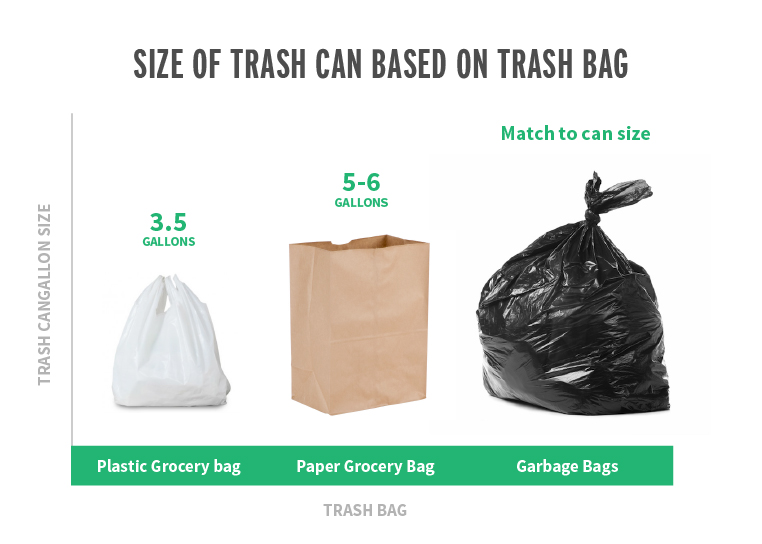
Image Source: trashcansunlimited.com
Deciphering Kitchen Trash Bag Dimensions
The size of a kitchen trash bag is usually expressed in gallons, but what does that really mean for the bag’s physical dimensions? The gallon size refers to the trash bag volume it can hold, not its flat, unrolled measurements. Manufacturers use this standardized system to help consumers match bags to their bins.
Common Trash Bag Sizes and Their Measurements
Let’s break down the most frequently encountered kitchen trash bag sizes:
-
4-gallon bags: These are often referred to as “small kitchen” or “canister” bags. They are ideal for smaller bins found in bathrooms, offices, or RVs.
- Typical Flat Dimensions: Approximately 20-22 inches wide by 24-26 inches long.
- Trash Bag Capacity: Designed to hold about 4 gallons of dry refuse.
-
8-10 gallon bags: These are a step up and often used for slightly larger kitchen bins or for general household waste where waste generation isn’t excessively high.
- Typical Flat Dimensions: Roughly 23-25 inches wide by 28-30 inches long.
- Trash Bag Capacity: These bags can hold around 8 to 10 gallons of waste.
-
13-gallon bags: This is perhaps the most iconic standard kitchen trash bag size. It’s the go-to for most full-sized kitchen trash cans that hold about 13 gallons.
- Typical Flat Dimensions: Typically measure around 27-28 inches wide by 31-33 inches long.
- Trash Bag Capacity: These are meant to hold up to 13 gallons of trash.
-
20-gallon bags: A bit larger than the standard, these are good for households that produce more waste or have slightly bigger bins.
- Typical Flat Dimensions: Generally about 30-32 inches wide by 34-36 inches long.
- Trash Bag Capacity: Suitable for approximately 20 gallons of refuse.
-
30-35 gallon bags: These are for larger kitchen bins or for situations where you might be collecting more substantial amounts of waste, like during a party or clean-out.
- Typical Flat Dimensions: Around 33-35 inches wide by 39-42 inches long.
- Trash Bag Capacity: Can handle up to 30-35 gallons of waste.
Understanding the “Gallon” Measurement
The trash bag gallon size is a measure of volume, not a direct indicator of the bag’s dimensions when laid flat. Think of it like a liquid measure. A 13-gallon bag is designed to comfortably contain the amount of material that would fill a 13-gallon container. The extra length and width in the bag’s construction allow it to stretch and conform to the shape of your bin.
Table: Common Kitchen Trash Bag Sizes vs. Bin Capacity
| Bag Size (Gallons) | Typical Bin Size (Gallons) | Approximate Flat Width (inches) | Approximate Flat Length (inches) |
|---|---|---|---|
| 4 | 3-5 | 20-22 | 24-26 |
| 8-10 | 7-9 | 23-25 | 28-30 |
| 13 | 10-13 | 27-28 | 31-33 |
| 20 | 15-18 | 30-32 | 34-36 |
| 30-35 | 20-30 | 33-35 | 39-42 |
Note: These are typical dimensions and can vary slightly between brands and specific product lines.
Gauging Trash Bag Capacity: How Much Trash Does a Kitchen Bag Hold?
The kitchen garbage bag capacity is not just about the gallon number; it’s also about the bag’s strength and how you pack it. A well-designed bag will hold its stated capacity without tearing, but it’s essential to consider the type of waste.
Factors Influencing True Capacity
- Bag Material and Thickness: Thicker bags (measured in mils) are more durable and can often hold more weight and volume without breaking.
- Shape of the Bin: A cylindrical bin might distribute waste differently than a rectangular one, affecting how well the bag conforms and how much it can ultimately hold.
- Type of Waste: Wet, heavy, or sharp waste will put more strain on the bag than dry, light refuse. You might find that a 13-gallon bag filled with food scraps feels heavier and more prone to tearing than a 13-gallon bag filled with paper.
- How You Pack: Stuffing the bag too tightly can cause it to rip, even if the total volume of waste is within the stated capacity.
Relating Trash Bag Volume to Real-World Waste
So, how much trash does a kitchen bag hold in practical terms?
- A 4-gallon bag might handle a few days’ worth of bathroom waste or the daily scraps from a single person’s kitchen.
- An 8-10 gallon bag is suitable for a smaller family or for secondary bins around the house.
- The 13-gallon kitchen bin liner dimensions are perfectly suited for the average family’s daily kitchen waste for at least a day or two, depending on eating habits and recycling practices.
- A 20-gallon bag can often last longer for a family or handle bulkier items.
- The 30-35 gallon kitchen bin liner dimensions are for heavy-duty use, hosting events, or managing larger volumes of recyclables.
Matching the Bag to Your Bin: A Practical Approach
The most reliable way to find the right kitchen trash bag size is to measure your bin.
Measuring Your Kitchen Bin
- Height: Measure from the bottom of the bin to the top rim.
- Width and Depth (for rectangular bins): Measure the width and depth of the bin’s opening.
- Diameter (for round bins): Measure across the widest part of the bin’s opening.
Once you have these measurements, you can compare them to the typical dimensions of trash bags. A good rule of thumb is that the bag’s length should be about 10-15 inches longer than the bin’s height, and the bag’s width (when laid flat) should be roughly double the bin’s width or diameter. This extra length allows for a good overhang to secure the bag to the rim.
Example: Fitting a 13-Gallon Bag
Let’s say your kitchen bin is 20 inches high and 15 inches wide.
- Height Check: The bag needs to be at least 20 inches + 10 inches (for overhang) = 30 inches long. A typical 13-gallon bag is around 31-33 inches long, which is perfect.
- Width Check: The bag needs to be at least 15 inches * 2 = 30 inches wide (when laid flat). A typical 13-gallon bag is around 27-28 inches wide. This might seem a bit snug, but the plastic is designed to stretch. You want the bag to come up and over the rim comfortably. If the bag width is significantly less than double the bin’s width, you might find it difficult to tie off.
Different Types of Kitchen Trash Bags
Beyond size, consider these variations:
- Drawstring vs. Tie-Top: Drawstring bags offer a convenient way to close and carry the bag. Tie-top bags provide a simple closure.
- Heavy Duty: Made with thicker plastic to prevent tears from heavy or sharp items.
- Odor Control: Infused with scents or charcoal to neutralize smells.
- Recycled Content: Eco-friendly options made from post-consumer recycled materials.
Frequently Asked Questions About Kitchen Trash Bags
Q1: What is the most common kitchen trash bag size?
A1: The most common standard kitchen trash bag is the 13-gallon size, which is designed to fit most standard kitchen trash cans.
Q2: Can I use a larger trash bag if mine doesn’t have my exact size?
A2: Yes, you can often use a slightly larger bag. For instance, if you need a 10-gallon bag, a 13-gallon bag will likely work, but you’ll have more excess bag to fold over or tuck. Using a significantly larger bag might result in too much slack, making it harder to keep in place and tie.
Q3: How do I know what trash bag capacity my bin needs?
A3: The best way is to measure your bin. Look at the label on your existing bin; it often states its capacity in gallons. If not, measure the height and width/diameter of your bin and use online converters or the guidelines provided in this article to estimate the required bag size.
Q4: What does “mil thickness” mean for trash bags?
A4: “Mil thickness” refers to the strength and durability of the plastic. A mil is one-thousandth of an inch. Standard kitchen trash bags might be around 0.5-0.8 mils, while heavy-duty bags can range from 1.0 mil up to 3.0 mils or more. Higher mil thickness generally means a stronger, more tear-resistant bag.
Q5: How much trash does a 13-gallon kitchen bag actually hold?
A5: A 13-gallon kitchen trash bag is designed to hold up to 13 gallons of volume. In terms of weight, this can vary greatly depending on the material. For general household waste, it might comfortably hold 10-20 pounds. For heavier items like food scraps, it might hold less volume before becoming too heavy to manage.
Q6: Are there specific kitchen bin liner dimensions I should look for?
A6: While the gallon size is the primary indicator, paying attention to the actual flat width and length can be helpful, especially if your bin is an unusual shape or size. The table above provides typical dimensions for common gallon sizes.
Q7: Why do some bags say “fits 10-13 gallon bins”?
A7: This is to accommodate variations in bin design. Some 10-gallon bins might be slightly taller or wider than others, and a bag designed to fit a range ensures it works for most common bin types within that capacity. The trash bag volume capacity is the key, but the flexibility in the bag’s dimensions allows it to adapt.
By now, you should have a clearer picture of how big a kitchen trash bag is and the factors that determine its capacity and fit. Selecting the right bag makes a small but significant difference in managing household waste efficiently and cleanly.