
Determining the right number of can lights for your kitchen involves a few key considerations. Generally, for standard 6-inch can lights, you’ll want to place them about 4-6 feet apart, depending on the ceiling height and desired light output. A good starting point for recessed lighting calculation is to divide the room’s length by your chosen spacing and do the same for the width, then multiply those numbers. However, this is just a starting point; factors like task lighting needs and personal preference play a significant role in creating an effective kitchen lighting layout.
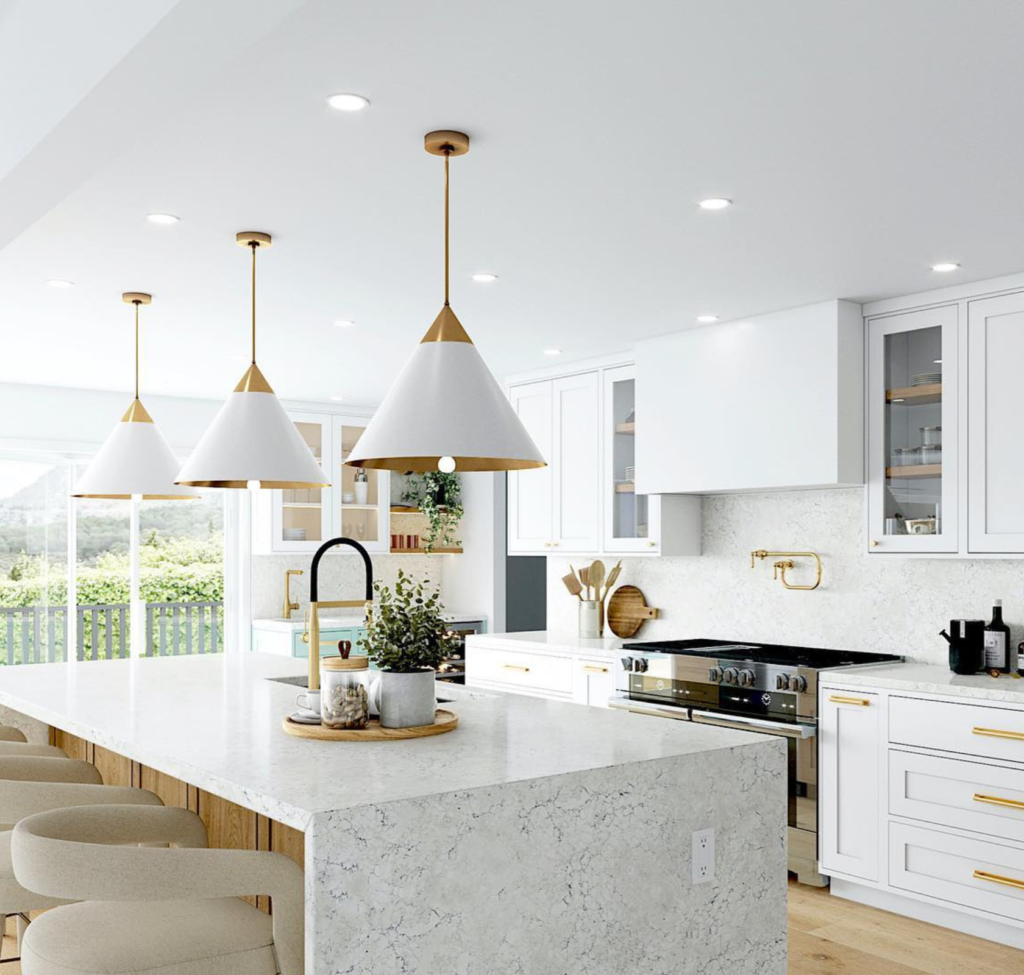
Image Source: blog.1800lighting.com
Planning Your Kitchen Lighting Design
A well-lit kitchen is more than just a place to cook; it’s the heart of the home. It’s where meals are prepared, conversations flow, and memories are made. That’s why a thoughtful kitchen lighting design is so crucial. Beyond just illumination, it impacts the mood, functionality, and overall aesthetic of the space. When we talk about “how many can lights for a kitchen,” we’re really asking how to achieve the best light for every activity. This involves layers of light: ambient, task, and accent. Can lights, also known as recessed lights, are often the backbone of the ambient layer, providing a clean, uncluttered look. But their placement and quantity need careful planning to avoid shadows and ensure even illumination.
The Role of Ambient Lighting
Ambient lighting is the general illumination that fills a room. It’s the foundation upon which all other lighting is built. In a kitchen, ambient lighting ensures you can comfortably move around, see your surroundings, and feel a sense of spaciousness. Can lights excel at this. When strategically placed, they create a bright, even glow across the entire ceiling and down into the living area. The goal is to create a comfortable, inviting atmosphere without harsh glare. Too few can lights can leave dark corners and feel dim, while too many can create an overwhelming, spa-like effect that might not be desirable for a kitchen’s primary function.
Task Lighting Essentials
While can lights provide a good base, they often aren’t enough for specific tasks. This is where task lighting comes in. Think about the areas in your kitchen where you’ll be doing detailed work: chopping vegetables at the counter, reading recipes, or washing dishes at the sink. Under-cabinet lighting is a prime example of task lighting, casting light directly onto your countertops without creating shadows that can occur with overhead lights. Pendant lights over an island or sink also serve as excellent task lights. When planning your kitchen ceiling lights, consider how your can lights will complement these dedicated task sources.
Accent Lighting for Ambiance
Accent lighting adds depth and visual interest to your kitchen. It’s used to highlight specific features, such as artwork, architectural details, or decorative objects. While not strictly part of how many recessed lights per room, it’s an important consideration in the overall kitchen lighting design. Gimbal or adjustable can lights can be used for accent lighting, allowing you to direct the beam precisely where you want it.
Deciphering Can Light Spacing: The Foundation of Your Layout
The spacing of your can lights is perhaps the most critical factor in determining number of can lights. Incorrect spacing can lead to a poorly lit kitchen with uneven light distribution, dark spots, and distracting glare. Achieving optimal can light placement requires a balance between light output, ceiling height, and the size of your kitchen.
The 2×2 Rule: A Simple Starting Point
A widely used guideline, often referred to as the “2×2 rule,” suggests dividing the ceiling height by two to determine the spacing between your can lights. For example, if your ceilings are 8 feet high, you would space your lights approximately 4 feet apart. This rule is a good starting point, but it’s not a definitive answer for how many can lights for a kitchen.
| Ceiling Height | Approximate Spacing |
|---|---|
| 8 feet | 4 feet |
| 9 feet | 4.5 feet |
| 10 feet | 5 feet |
Fathoming the Foot-Candle Requirement
Another approach to recessed lighting calculation involves considering the desired light levels, measured in foot-candles (fc). Different areas of the kitchen require different levels of illumination.
- General Living Areas: 10-20 fc
- Kitchen Counters/Work Areas: 30-50 fc
- Sink Area: 50-75 fc
To calculate the number of lights needed to achieve these levels, you’ll need to know the lumen output of your chosen can lights and the square footage of your kitchen. A simplified formula is:
Total Lumens Needed = Desired Foot-Candles x Kitchen Area (sq ft)
Then, divide the Total Lumens Needed by the lumens per fixture to get the number of fixtures. However, this is a very basic calculation and doesn’t account for light loss due to diffusers, ceiling bounce, or fixture efficiency. A more accurate recessed fixture spacing guide will factor these in.
Considering Fixture Size and Beam Spread
The size of your can lights and their beam spread significantly impact spacing. Can lights come in various sizes, most commonly 4-inch, 6-inch, and 8-inch.
- 4-inch cans: Generally have a narrower beam spread, meaning they concentrate light in a smaller area. This makes them suitable for hallways or accent lighting, but you’ll need more of them for general kitchen illumination.
- 6-inch cans: The most popular choice for kitchens, offering a good balance of coverage and focused light. Standard can light spacing often refers to 6-inch fixtures.
- 8-inch cans: Have a wider beam spread and can cover a larger area with fewer fixtures. However, their larger size can sometimes feel imposing on lower ceilings.
The beam spread, often indicated in degrees or as a “flood” (wider spread) or “spot” (narrower spread) designation, also dictates how close lights need to be to achieve even coverage. Wider beam spreads allow for greater spacing.
Key Areas for Can Light Placement in a Kitchen
Beyond general spacing, specific areas in your kitchen benefit from targeted optimal can light placement. Thinking about zones within your kitchen is crucial for an effective kitchen lighting layout.
Over Work Surfaces and Islands
These are your primary task areas. You want bright, shadow-free light here. For countertops, placing can lights a foot or two away from the wall (or cabinet edge) helps illuminate the backsplash and the entire counter surface.
- On Countertops: Space lights 4-6 feet apart, starting about 12-18 inches from the wall.
- Over Kitchen Islands: This is a key focal point. You can either place can lights in a grid pattern over the island, similar to the general ceiling layout, or use them in conjunction with pendant lights. If using can lights exclusively, spacing them to mirror the general ceiling layout, typically 3-4 feet apart, is common. Ensure the light is directed to cover the entire surface of the island.
In the Center of the Room
For general ambient light, placing can lights in the center of each ceiling grid section (e.g., 4×4 foot or 5×5 foot squares) often provides the most even distribution. This is where the standard can light spacing guidelines are most applicable.
Above the Sink
The sink area is a crucial task zone. Good lighting here is essential for washing dishes and preparing food. Place a can light directly above the center of the sink, or consider placing two lights on either side to minimize shadows.
At the Perimeter of the Room
For a softer, more diffused light and to reduce glare, consider placing some can lights along the perimeter of the kitchen, pointing slightly towards the walls. This can create a beautiful glow and make the room feel larger. This is a great way to incorporate accent lighting as well.
Factors Influencing the Number of Can Lights
Several variables will influence your final decision on how many can lights for a kitchen. It’s a personalized calculation.
Ceiling Height
As mentioned, higher ceilings require wider spacing between lights to achieve even illumination. Lower ceilings might benefit from smaller aperture lights (4-inch) and tighter spacing to avoid an overwhelming number of fixtures.
Room Dimensions
The overall square footage and shape of your kitchen are fundamental to determining number of can lights. A long, narrow kitchen will have a different layout than a square one. You’ll want to ensure coverage extends to all corners and edges.
Light Fixture Lumens and Beam Spread
Higher lumen output lights with wider beam spreads can cover more area, potentially reducing the total number of fixtures needed. Conversely, lower lumen or narrower beam spread lights will require closer spacing and more fixtures.
Personal Preference and Lighting Goals
Do you prefer a very bright, task-oriented kitchen, or a softer, more ambient feel? Your personal preferences play a significant role in determining number of can lights. Some people prefer more light for cooking, while others are happy with fewer, more strategically placed lights, relying on other sources for task lighting.
Existing Lighting and Future Additions
If you have other light sources, like pendant lights or under-cabinet lighting, you might need fewer can lights for general illumination. It’s also worth considering if you plan to add more lighting in the future.
Recessed Lighting Calculation: A Practical Approach
Let’s walk through a practical example to illustrate recessed lighting calculation.
Scenario: A rectangular kitchen that is 10 feet wide by 15 feet long, with 8-foot ceilings.
Step 1: Determine Spacing
Using the 2×2 rule (Ceiling Height / 2), we get 8 feet / 2 = 4 feet spacing.
Step 2: Calculate Lights Along the Width
Room Width (10 ft) / Spacing (4 ft) = 2.5. Since you can’t have half a light, round up to 3 lights along the width.
Step 3: Calculate Lights Along the Length
Room Length (15 ft) / Spacing (4 ft) = 3.75. Round up to 4 lights along the length.
Step 4: Total Can Lights (Initial Grid)
Number of lights along width x Number of lights along length = 3 lights x 4 lights = 12 can lights.
Step 5: Refine Placement for Functionality
This initial calculation gives us a general grid. Now, we need to refine this based on specific kitchen zones:
- Is the island centered? If so, adjust the grid to ensure lights are appropriately placed over it. For a 15-foot length, with 4-foot spacing, lights might be at 2ft, 6ft, 10ft, and 14ft from one end. If an island is in the middle (say, at the 7.5ft mark), you might adjust the spacing to center lights over it.
- Countertops: We need to ensure coverage along the countertops. Let’s say there are countertops along both 15-foot walls. Placing lights 18 inches from the wall means the first row of lights will be about 1.5 feet from the edge. If the total width is 10 feet, and we have two rows of lights, the remaining 7 feet would be between them. If we place the second row of lights 4 feet from the first, they’d be at 1.5ft and 5.5ft from one wall, leaving 4.5ft to the other wall. This placement might be a bit off-center for the far wall.
- Recalculating for better coverage: Let’s try spacing the lights 5 feet apart for better coverage over the island and counters, given the 8-foot ceiling.
- Width (10 ft) / 5 ft = 2 lights. Placing them 2.5 ft from each wall provides good side coverage.
- Length (15 ft) / 5 ft = 3 lights. Placing them at approximately 2.5 ft, 7.5 ft, and 12.5 ft from one end would offer good coverage along the length.
- Total lights: 2 lights x 3 lights = 6 can lights.
This revised calculation of 6 lights provides a much better kitchen lighting layout for this specific kitchen size and desired spacing, ensuring good coverage over work areas and the center. This is a more efficient use of kitchen ceiling lights than the initial 12.
Important Considerations for Your Calculation:
- Obstructions: Consider any ceiling fans, bulkheads, or structural beams that might limit placement.
- Light Distribution: Aim for overlapping beams of light to avoid dark patches.
Standard Can Light Spacing and Common Mistakes
While there are guidelines, understanding common mistakes can save you from a lighting nightmare.
Mistake 1: Over-Spacing
Placing lights too far apart is a very common error. This leads to dark spots, shadows, and a general feeling of dimness. You’ll end up relying too heavily on task lighting, which might not be ideal for the overall ambiance.
Mistake 2: Under-Spacing
Conversely, too many lights can make a kitchen feel like a sterile operating room. It can also be a waste of money on fixtures and energy. There’s a point of diminishing returns.
Mistake 3: Ignoring Task Areas
Simply placing lights in a uniform grid across the entire ceiling without considering where work will actually happen is a significant oversight in kitchen lighting design.
Mistake 4: Using the Same Fixture Everywhere
While can lights are great for ambient light, consider if adjustable trims or different beam spreads are needed for specific areas to improve optimal can light placement.
Mistake 5: Forgetting the Periphery
Lights placed only in the center of the room can leave the edges of the kitchen feeling dark. Some perimeter lighting can dramatically improve the overall feel.
Choosing the Right Can Lights
Beyond the number and placement, the type of can light you choose matters.
Trim Types
- Standard/Baffle Trim: Features ridges that help reduce glare. Good for general illumination.
- Gimbal Trim: Allows you to angle the light source, useful for accent lighting or directing light onto specific areas.
- Adjustable Trim: Similar to gimbal trims, allowing for directional control.
- Recessed Reflector Trim: Designed to maximize light output and direct it downwards.
Bulb Types
- LED: The most energy-efficient and longest-lasting option. They come in various color temperatures (warm to cool) and brightness levels.
- Halogen: Still used, but less energy-efficient than LEDs. They offer a warm, familiar light.
- CFL: Less common now due to the rise of LEDs, but they were a more energy-efficient option than incandescent bulbs.
When selecting bulbs, consider the lumen output for brightness and the Kelvin temperature for color (warm white is around 2700K-3000K, cool white is 4000K-5000K). For kitchens, a warm white to neutral white (2700K-4000K) is generally preferred.
Frequently Asked Questions (FAQ)
How many recessed lights do I need for a 10×10 kitchen?
For a 10×10 kitchen with 8-foot ceilings, a good starting point using a 4-foot spacing guideline would be 4 lights (2 along each dimension). You might consider 6 lights for better coverage, especially if you have an island or specific task areas.
Can I use 4-inch can lights instead of 6-inch?
Yes, you can use 4-inch can lights. You will likely need more of them due to their narrower beam spread and lower lumen output. They are often preferred for lower ceilings or in kitchens with a more modern aesthetic. For a 10×10 kitchen, you might need 8-10 four-inch lights, spaced about 3 feet apart.
What is the maximum distance between can lights?
The maximum distance is generally dictated by the ceiling height and the beam spread of the fixture. A common rule of thumb is that the distance between lights should not exceed the ceiling height. For example, on 8-foot ceilings, spacing lights no more than 8 feet apart is a general maximum. However, to achieve even lighting and avoid dark spots, spacing them closer, typically 4-6 feet apart for 6-inch cans, is recommended.
Do I need a specific kitchen lighting layout for new construction?
Yes, when building a new home or undertaking a major renovation, it’s the ideal time to plan your kitchen lighting layout. Consulting with a lighting designer or electrician during the blueprint phase ensures that wiring is correctly placed for your recessed lighting calculation and optimal can light placement from the start. This avoids costly rework later.
Who should I consult for help with my kitchen lighting?
For kitchen lighting design, consulting a professional lighting designer or an experienced electrician is highly recommended. They can help you with your recessed lighting calculation, advise on the best fixture types, and ensure your kitchen ceiling lights are installed safely and effectively according to can light spacing best practices.
Is there a rule for how many recessed lights per room?
While there isn’t a single, universally mandated “how many recessed lights per room” rule, general guidelines and calculations based on room size, ceiling height, and desired light levels are used to create effective lighting plans. The goal is to achieve sufficient illumination without creating glare or dark areas.
How close should can lights be to the wall?
For countertops, can lights should typically be placed 12-18 inches away from the wall to effectively illuminate the backsplash and the entire counter surface without casting shadows. For general ambient lighting in the center of the room, the spacing is dictated by the room dimensions and ceiling height.
What is the best recessed fixture spacing guide for a galley kitchen?
For galley kitchens, which are long and narrow, it’s often best to run a single row of can lights down the center of the kitchen, spaced according to your ceiling height (e.g., 4-6 feet apart for 8-foot ceilings). You might also consider placing lights along the perimeter over the countertops if the kitchen is wide enough to avoid shadows when working at the counters.
Creating the perfect kitchen lighting layout is an art and a science. By considering can light spacing, recessed lighting calculation, and the specific needs of your kitchen, you can achieve a beautifully and functionally lit space. Remember, it’s about layers of light working together to create the ideal environment for cooking, dining, and living.