
The standard kitchen countertop height for most home kitchens is 36 inches from the finished floor to the top of the countertop. This height is designed to accommodate the majority of adults, providing a comfortable workspace for common kitchen tasks. However, variations in this standard exist, and the ideal height can depend on several factors, including the average height of the users, the specific activities performed at the counter, and accessibility requirements.
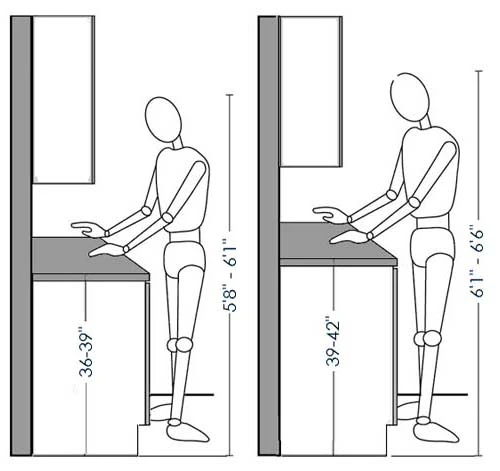
Image Source: www.regattaexports.com
Determining Your Ideal Kitchen Counter Height
When planning a kitchen renovation or building a new home, selecting the right kitchen counter height is crucial for both functionality and comfort. While a standard countertop height is widely adopted, personalizing this dimension can significantly enhance your workspace height and the overall counter height usability. Let’s delve into the factors that influence this important decision.
The Standard: 36 Inches of Comfort
The 36-inch benchmark for kitchen counter height has been a staple for decades. This height is a result of a blend of historical practices and ergonomic considerations that aim to serve the average adult. It strikes a balance, allowing most people to stand comfortably while chopping vegetables, kneading dough, or preparing meals. This standard countertop height is also conveniently aligned with the typical height of most base cabinets, simplifying the manufacturing and installation process.
Why 36 Inches Works (Mostly)
- Broad Accessibility: It caters to a wide range of adult heights, making it a universally accepted choice for many homes.
- Cabinetry Integration: Standard base cabinets are designed to be 34.5 inches tall, which, when combined with a standard 1.5-inch countertop thickness, results in the 36-inch finished height. This simplifies kitchen design and manufacturing.
- Ergonomic Sweet Spot: For many, 36 inches allows for a relatively natural posture, reducing strain on the back and shoulders during prolonged kitchen tasks.
Beyond the Standard: When to Adjust
While 36 inches is the norm, it’s not a one-size-fits-all solution. Ergonomic kitchen design emphasizes adapting the space to the user, not the other way around. Several scenarios warrant a deviation from the standard:
1. User Height and Stature
The most significant factor influencing counter height usability is the height of the primary users.
For Taller Individuals
If the main cooks in the household are significantly taller than average, a higher countertop can provide a more comfortable counter height and reduce bending. For every inch above 5’10”, consider increasing the countertop height inches by half an inch to an inch.
- Example: An individual who is 6’2″ might find 37-38 inches a more comfortable counter height.
For Shorter Individuals
Conversely, shorter individuals may benefit from lower countertops. A counter height inches that allows them to reach the surface without raising their shoulders can greatly improve comfort and reduce fatigue.
- Example: Someone who is 5’2″ might feel more comfortable with a countertop height of 34-35 inches.
2. Specific Kitchen Tasks
Different kitchen activities benefit from different workspace height levels.
- Baking and Dough Work: Many bakers prefer a slightly lower surface, typically around 30-33 inches, to allow for better leverage when kneading dough or rolling out pastry. This lower height puts less stress on the wrists and back.
- Food Preparation: Standard 36-inch counters are generally excellent for general chopping and food prep.
- Standing/Gathering Areas: If a counter section is primarily used for serving or as a casual gathering spot, it might be raised to bar height (around 42 inches).
3. Accessibility and ADA Compliance
For individuals with mobility issues or disabilities, ADA countertop height regulations are paramount. The Americans with Disabilities Act (ADA) provides guidelines to ensure accessibility.
- Clearance: A minimum of 27 inches of clear knee space is required under countertops.
- Height: Accessible countertops should have a maximum height of 34 inches.
- Forward Reach: The maximum height for a forward approach is 36 inches.
- Side Reach: The maximum height for a side approach is 34 inches.
It’s important to note that these are minimum and maximum requirements, and the goal is to create a functional and comfortable space within these guidelines.
4. Kitchen Island Height
Kitchen island height can be a little more flexible. Often, kitchen islands serve multiple purposes, including food preparation, dining, and socializing.
- Standard Height Island: If the island functions primarily as an extension of the main counter, 36 inches is suitable.
- Bar Height Island: For a breakfast bar or casual dining area, a kitchen island height of 42 inches is common, often paired with stools.
- Multi-Level Island: Some islands feature different heights to accommodate various activities. For example, a lower section for food prep (36 inches) and a higher section for seating (42 inches).
Measuring for Your Perfect Height
To accurately determine your ideal counter height inches, consider these steps:
- Measure Your Elbow Height: Stand comfortably with your arms relaxed at your sides. Have someone else measure from the floor to your elbow. The ideal countertop height is typically 2-6 inches below your elbow.
- Simulate Tasks: Use temporary surfaces at different heights (e.g., sturdy boxes, chairs) to mimic working at various counter heights. Perform common kitchen tasks like chopping, stirring, and washing dishes to feel what is most comfortable for your body.
- Consider All Users: If multiple people regularly use the kitchen, find a height that is a reasonable compromise or consider different height zones within the kitchen.
- Consult with Professionals: Kitchen designers and cabinet makers can offer expert advice based on your specific needs and the layout of your kitchen.
The Mechanics of Countertop Height: Cabinets and Thickness
The final countertop height inches are a combination of the base cabinet height and the thickness of the countertop material. Understanding this relationship is key to achieving your desired workspace height.
Base Cabinet Heights
Standard base cabinets are typically manufactured to a height of 34.5 inches. These cabinets sit on the floor and provide the foundational structure for your countertops.
Countertop Thickness Variations
Countertop materials come in varying thicknesses, which directly impact the final counter height inches.
| Countertop Material | Typical Thickness (inches) | Notes |
|---|---|---|
| Laminate | 0.75 – 1.5 | Often designed to fit standard cabinet heights. |
| Butcher Block | 1.5 – 2 | Offers a warm aesthetic and can be sanded and refinished. |
| Granite/Quartz | 0.75 (2cm), 1.25 (3cm) | 1.25-inch (3cm) is more common in North America for a substantial look. |
| Marble | 0.75 – 1.25 | Can be more delicate, thickness chosen for durability and aesthetics. |
| Solid Surface | 0.5 – 1.5 | Versatile and can be molded, often installed with a sub-layer for stability. |
| Concrete | 1.5 – 2 | Heavy material, thickness contributes to its substantial feel and durability. |
| Stainless Steel | 0.75 – 1.5 | Often used in professional kitchens, can be welded for seamless appearance. |
Calculating Your Finished Height:
- Standard Setup: 34.5 inches (cabinet) + 1.5 inches (countertop) = 36 inches (finished height)
- For a Lower Counter: Use shorter base cabinets (custom order) or a thinner countertop material. For example, 33 inches (cabinet) + 1 inch (countertop) = 34 inches.
- For a Higher Counter: Use taller base cabinets or a thicker countertop material. For example, 35.5 inches (cabinet) + 1.5 inches (countertop) = 37 inches.
Custom Cabinetry and Countertops
If you’re opting for a non-standard kitchen counter height, you may need to consider custom base cabinets or have your countertops fabricated to a specific thickness. This allows for precise tailoring of your workspace height to your exact needs.
Countertop Depth: A Crucial, Often Overlooked Dimension
While kitchen counter height is frequently discussed, countertop depth is equally important for usability and workflow. The standard countertop depth is 25 inches. This measurement is taken from the wall-side edge of the countertop to the front edge.
Why Standard Depth Matters
- Appliance Fit: Standard appliance widths (dishwashers, ranges) and depths are designed to integrate seamlessly with 25-inch deep countertops.
- Workspace: This depth provides ample space for food preparation, appliance placement (like mixers or toasters), and maneuvering cooking utensils.
- Cabinetry Interior: The 25-inch depth accommodates standard base cabinet interiors, typically around 24 inches deep, leaving a small overhang at the front.
When to Consider Different Depths
- Deeper Counters for More Space: In kitchens with ample space, or for those who do a lot of extensive food prep, a deeper countertop (e.g., 30 inches or more) can offer significantly more workspace height and utility. This allows for larger appliances to be placed further back, freeing up the front edge for active prep.
- Shallower Counters for Narrower Kitchens: In very compact kitchens or tight walkways, shallower countertops (e.g., 20-22 inches) might be necessary to maintain adequate traffic flow. However, this comes at the cost of reduced workspace.
- Overhangs: The overhang at the front of the countertop is typically 1 to 1.5 inches, allowing for comfortable knee clearance and a finished look. The total depth of the countertop, including overhang, is what dictates the usable depth.
Ergonomic Design Principles for a Comfortable Kitchen
Ergonomic kitchen design is about creating a kitchen that is safe, comfortable, and efficient for its users. Beyond just counter height inches, several other factors contribute to an ergonomic kitchen.
Key Ergonomic Considerations
- Work Triangle: The traditional “work triangle” (sink, refrigerator, and stove) remains a fundamental concept for efficient workflow. Optimizing the distances between these points reduces unnecessary steps.
- Clearances: Ensuring adequate clearance between countertops, islands, and appliances is vital for comfortable movement and safe operation. Aim for at least 42 inches of clearance in high-traffic areas.
- Lighting: Proper task lighting over prep areas and sinks is essential to prevent eye strain and improve safety.
- Appliance Placement: Heavy appliances like ovens and refrigerators should be positioned for easy access, minimizing awkward reaching or lifting.
- Storage Solutions: Well-organized and easily accessible storage, such as pull-out shelves and drawers, reduces the need for bending and reaching.
Creating a Comfortable Counter Height
Achieving a truly comfortable counter height involves a holistic approach.
- Task-Specific Zones: Consider creating different height zones within your kitchen. A lower baking station, a standard prep area, and a higher bar-height island can cater to various needs.
- Varying User Heights: If you have a significant difference in height among household members, consider how a single standard countertop height might affect each person. Customization might be the best solution.
- Future Needs: Think about potential future needs, such as aging in place or accommodating guests with different physical abilities.
Adapting for Specific Needs and Styles
The beauty of modern kitchen design is its flexibility. You are not bound by the standard countertop height.
ADA and Universal Design
ADA countertop height guidelines are a cornerstone of universal design, aiming to make spaces accessible to as many people as possible. Incorporating these principles, even if not strictly required, can create a more inclusive and user-friendly kitchen. A kitchen island height can also be designed with accessibility in mind, perhaps featuring a lower section for wheelchair users.
The Impact of Countertop Material on Height
While most materials can be cut to size, some naturally lend themselves to specific thicknesses that influence the final counter height inches.
- Stone (Granite, Quartz, Marble): Typically come in 2cm (0.75 inch) and 3cm (1.25 inch) slabs. The 3cm option is very popular as it provides a robust appearance and works perfectly with standard 34.5-inch cabinets for the 36-inch standard.
- Laminate: Generally thinner, often around 0.75 inches. To achieve a 36-inch height, you’d typically use a standard 35.25-inch base cabinet.
- Butcher Block: Can be milled to various thicknesses, offering flexibility. A 1.5-inch butcher block on a standard 34.5-inch cabinet results in a 36-inch height. Thicker options, like 2 inches, would require adjusting the base cabinet height.
Material Thickness and Structural Integrity
It’s important to consider the structural integrity of your chosen material when deviating from standard thicknesses. Thicker stone slabs offer more durability. Thin laminate might require additional support. Always consult with your fabricator about the best thickness for your material and desired counter height inches.
Frequently Asked Questions (FAQ)
Q1: Can I put a 3cm (1.25 inch) countertop on a 34.5-inch cabinet and still have 36 inches?
A1: Yes. A 34.5-inch cabinet plus a 1.25-inch thick countertop equals a total height of 35.75 inches. This is very close to the standard 36 inches and generally considered acceptable.
Q2: What is the standard overhang for kitchen countertops?
A2: The standard overhang for kitchen countertops is typically 1 to 1.5 inches beyond the cabinet face. This allows for comfortable knee clearance and a finished look.
Q3: Is a 36-inch kitchen counter height good for everyone?
A3: While 36 inches is the standard and works for many, it’s not ideal for everyone. Shorter or taller individuals, or those with specific physical needs, may find a different comfortable counter height more beneficial.
Q4: What is the minimum counter height for ADA compliance?
A4: The ADA specifies a maximum counter height of 34 inches for accessible counters, with a minimum of 27 inches of clear knee space underneath.
Q5: How do I determine the best counter height for my kitchen island?
A5: Consider the primary uses of your island. If it’s for prep, 36 inches is good. If it’s for casual dining, 42 inches (bar height) is more appropriate. Multi-level islands can combine these.
Q6: What is the standard countertop depth?
A6: The standard countertop depth is 25 inches, designed to work with standard base cabinets and appliances.
Q7: Can I have different countertop heights in my kitchen?
A7: Absolutely! Many modern kitchens feature multi-level countertops to accommodate different tasks and user preferences, enhancing counter height usability.
Q8: What are the benefits of ergonomic kitchen design?
A8: Ergonomic kitchen design focuses on comfort, safety, and efficiency. It can reduce physical strain, prevent injuries, and make kitchen tasks more enjoyable and less tiring, leading to a more comfortable counter height and overall workspace.