
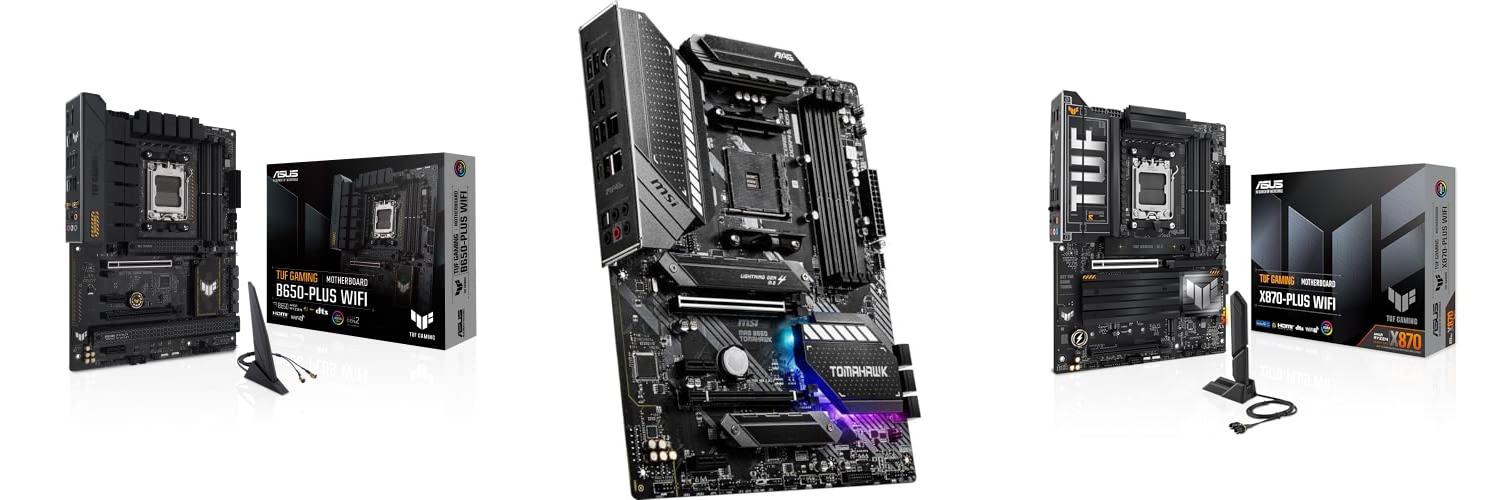
Ever feel like your computer is holding you back? Maybe it’s slow to start, or games don’t run as smoothly as you’d like. A big reason for this can be the motherboard, the backbone of your entire system. Choosing the right AMD motherboard can feel like navigating a maze. There are so many different kinds, and figuring out which one fits your needs and budget can be a real headache.
Don’t worry, though! You’re not alone in this. We understand the frustration of trying to pick the perfect motherboard. That’s why we’re here to help. By the end of this post, you’ll know exactly what to look for. We’ll break down what makes a good AMD motherboard so you can build a PC that’s fast, reliable, and ready for anything.
Get ready to unlock your computer’s full potential. Let’s dive into the world of AMD motherboards and find the one that’s just right for you.
Our Top 5 Amd Motherboards Recommendations at a Glance
Top 5 Amd Motherboards Detailed Reviews
1. ASUS TUF GAMING B650-PLUS WIFI AMD B650 AM5 Ryzen™ Desktop 9000 8000 and 7000 ATX motherboard

Rating: 9.5/10
The ASUS TUF GAMING B650-PLUS WIFI is a tough and reliable motherboard built for gamers. It’s ready for the latest AMD Ryzen processors. This board packs advanced features to boost your gaming experience and keep your system running smoothly.
What We Like:
- It supports the newest AMD Ryzen 7000 series processors, so your PC will be super fast.
- The power system is strong with 14 power stages, giving your CPU steady energy.
- You get super-fast storage with a PCIe 5.0 M.2 slot.
- Newer USB ports, including USB4 support, mean quick data transfers.
- Built-in WiFi 6 and 2.5 Gb Ethernet keep your internet connection speedy and stable for online games.
- Two-way AI Noise Cancelation makes your voice clear in games and calls, and also cleans up game sounds.
- Cooling is great with big heatsinks and smart fan controls to keep things from getting too hot.
- Aura Sync lets you customize the look of your PC with cool RGB lighting.
What Could Be Improved:
- While it has USB4 support, actual USB4 ports might require a separate card.
- The price might be a bit high for some budget builders.
Overall, the ASUS TUF GAMING B650-PLUS WIFI is a solid choice for gamers who want performance and reliability.
2. MSI MAG B550 TOMAHAWK Gaming Motherboard (AMD AM4

Rating: 9.2/10
The MSI MAG B550 TOMAHAWK is a powerful motherboard built for gamers. It supports the latest AMD Ryzen processors, so your games will run super fast. You can also upgrade your system later with future AMD processors. This board has great sound quality to make your games feel more real. It also keeps your components cool so they don’t overheat.
What We Like:
- Supports 3rd Gen AMD Ryzen processors and future AMD Ryzen processors (with BIOS update).
- Awesome studio-grade sound quality with Audio Boost.
- Super-fast gaming with PCIe 4.0 and Lightning Gen 4 M.2.
- Keeps components cool with a premium thermal solution.
- Dual LAN ports (2.5G and Gigabit) for fast internet.
- Mystic Light for cool RGB lighting effects.
- Plenty of USB ports, including fast AMD Turbo USB 3.2 GEN 2.
What Could Be Improved:
- The BIOS update for future processors might be a bit tricky for some users.
This motherboard offers a fantastic gaming experience with its speed and features. It’s a solid choice for anyone building a new gaming PC.
3. ASUS TUF Gaming X870-PLUS WiFi AMD AM5 X870 ATX Motherboard

Rating: 9.4/10
The ASUS TUF Gaming X870-PLUS WiFi motherboard is built for serious gamers and creators. It’s ready for the newest AMD Ryzen processors and future AI tasks. This board packs a punch with its strong power delivery and super-fast connections, making it a great foundation for a high-performance PC.
What We Like:
- Ready for future AI PCs and powerful AMD Ryzen 7000, 8000, and 9000 series processors.
- Strong power system with 16+2+1 80A SPS power stages and an 8-layer PCB for stable performance.
- Super-fast Wi-Fi 7 and 2.5Gb LAN for quick internet.
- Plenty of fast storage with four M.2 slots.
- New USB4® 40Gbps and USB 20Gbps Type-C ports for speedy data transfer.
- ASUS AI features like AI Overclocking and AI Cooling II make it easier to get the best performance.
- Supports the latest DDR5 memory and PCIe 5.0 for future upgrades.
What Could Be Improved:
- As a high-end motherboard, the price might be higher than some budget options.
- For beginners, the advanced features might seem a bit complex at first.
This motherboard offers top-tier performance and future-proofing for your PC build. It’s a solid choice for anyone looking to push their system to the limit.
4. MSI MAG X870 Tomahawk WiFi Gaming Motherboard (AMD Ryzen 9000/8000/7000 Series Processors

Rating: 9.0/10
The MSI MAG X870 Tomahawk WiFi Gaming Motherboard is a powerhouse for gamers who want the best. It supports the latest AMD Ryzen processors, including the 9000, 8000, and 7000 series. This board is built for speed and performance, with cutting-edge technology like DDR5 memory and PCIe 5.0 for lightning-fast data transfer. You can connect all your high-speed devices with USB 40Gbps ports and enjoy super-fast internet with its 5G LAN. Plus, the Audio Boost 5 feature makes your games sound incredible.
What We Like:
- It supports a wide range of powerful AMD Ryzen processors (9000/8000/7000 series).
- Lightning-fast USB 40Gbps ports are included for quick data transfers.
- The extended heatsink design keeps your processor cool, even under heavy load.
- A 5Gbps LAN port provides a super-fast internet connection for gaming.
- Audio Boost 5 delivers amazing sound for an immersive gaming experience.
- It comes with Wi-Fi 7 and Bluetooth 5.4 for the latest wireless connectivity.
What Could Be Improved:
- For some users, the ATX form factor might be larger than desired for smaller PC builds.
- While feature-rich, the price point may be higher than some budget-conscious gamers are looking for.
This motherboard is a fantastic choice for serious gamers looking for top-tier performance and features. It sets you up for an incredible gaming experience.
5. ASUS Prime B550M-A WiFi II AMD Micro ATX Motherboard with PCIe 4.0

Rating: 8.9/10
The ASUS Prime B550M-A WiFi II is a fantastic motherboard for building a powerful and modern PC. It’s designed for 3rd Gen AMD Ryzen CPUs and brings the latest technology to your build. This board packs in high-speed connections, smart cooling, and robust protection to keep your system running smoothly and reliably.
What We Like:
- It supports the latest 3rd Gen AMD Ryzen CPUs with the AM4 socket.
- You get super-fast speeds with PCIe 4.0 for your graphics card and M.2 SSDs.
- Built-in WiFi 6 means you have the fastest wireless internet available.
- It has dual M.2 slots, and one of them is also PCIe 4.0 for lightning-fast storage.
- You can connect modern displays with HDMI 2.1, supporting 4K at 60Hz.
- The board includes comprehensive cooling features like VRM and PCH heatsinks to keep things cool.
- ASUS’s 5X Protection III offers great safety for your components.
- OptiMem technology helps your memory run faster and more efficiently.
- It has an RGB header to add some flashy lights to your build.
What Could Be Improved:
- This is a Micro ATX board, so it’s smaller and might have fewer expansion slots than a full-sized ATX board.
- While it has a lot of features, it might not be the most budget-friendly option for very basic builds.
This ASUS Prime B550M-A WiFi II motherboard is a strong choice for gamers and creators looking for speed and reliability. It offers a great balance of modern features and solid build quality for a great PC experience.
Choosing the Right AMD Motherboard: Your Ultimate Guide
Picking the perfect motherboard for your AMD processor is like choosing the right foundation for your house. It needs to be strong, reliable, and have all the right connections for everything else you want to plug in. This guide will help you find the best AMD motherboard for your needs, whether you’re building a brand-new gaming PC or upgrading an older one.
1. Key Features to Look For
When you’re shopping for an AMD motherboard, keep these important features in mind:
- CPU Socket: This is where your AMD processor plugs in. AMD uses different socket types for different generations of CPUs. The most common are AM4 for older Ryzen processors and AM5 for newer ones. Make sure the socket on the motherboard matches your CPU!
- Chipset: The chipset is like the motherboard’s brain. It controls how different parts of your computer talk to each other. For AMD, you’ll see chipsets like B550, X570 (for AM4), and B650, X670 (for AM5). Higher-end chipsets often offer more features and better performance.
- RAM Slots: This is where your computer’s memory (RAM) goes. Most motherboards have 2 or 4 RAM slots. Make sure it supports the type and speed of RAM you want.
- Expansion Slots (PCIe): These slots let you add other cards, like a graphics card (GPU), sound card, or Wi-Fi card. The main one you’ll care about is the PCIe x16 slot for your graphics card. Newer motherboards support PCIe 4.0 or 5.0, which are faster.
- Storage Connectors (SATA & M.2): These are for your hard drives and SSDs. SATA ports are for older drives, while M.2 slots are for super-fast NVMe SSDs. More M.2 slots mean you can add more speedy storage.
- Rear I/O Ports: This is the back panel where you plug in your monitor, keyboard, mouse, USB devices, and Ethernet cable. Check to see if it has enough USB ports of the types you need (USB 3.0, USB-C).
- Form Factor: Motherboards come in different sizes. The most common are ATX (standard size), Micro-ATX (smaller), and Mini-ITX (very small). Make sure the motherboard fits in your computer case.
2. Important Materials
Motherboards are made of several layers of fiberglass and copper. The quality of these materials matters for how well the motherboard handles heat and electrical signals.
- PCB Layers: More layers generally mean a more robust board that can handle more power and heat.
- VRMs (Voltage Regulator Modules): These deliver power to your CPU. Good VRMs with sturdy heatsinks help keep your CPU running smoothly, especially if you plan to overclock.
3. Factors That Improve or Reduce Quality
Several things can make a motherboard better or worse:
- Build Quality: A well-built motherboard feels solid. It has good soldering and components that are neatly arranged. Cheaper boards might have less robust components.
- Cooling Solutions: Good motherboards have heatsinks on important parts like the VRMs and M.2 slots. These help prevent overheating, which can slow down your computer or even damage parts.
- BIOS/UEFI: This is the basic software on the motherboard. A user-friendly BIOS makes it easy to change settings and update the system. Some manufacturers offer better BIOS updates and support than others.
- Component Quality: Using high-quality capacitors and chokes helps the motherboard last longer and perform more reliably.
- Overclocking Support: If you want to push your CPU to run faster than its normal speed, you need a motherboard with good VRMs and BIOS options designed for overclocking.
4. User Experience and Use Cases
The motherboard you choose really changes how you use your computer.
- For Gamers: Gamers often need motherboards with good graphics card support (PCIe 4.0/5.0), fast M.2 slots for quick game loading, and plenty of USB ports for peripherals. Good cooling is also important for long gaming sessions.
- For Content Creators (Video Editors, Designers): These users benefit from motherboards with lots of RAM slots to handle large files, fast storage options, and good connectivity for external drives and monitors.
- For Everyday Use (Web Browsing, Office Work): For basic tasks, you don’t need the most expensive motherboard. A board with a reliable chipset, enough RAM slots, and basic connectivity will work perfectly.
- For Small Builds (Home Theater PCs, Compact Desktops): Mini-ITX motherboards are perfect for small spaces. They offer everything you need in a tiny package, though you might have fewer expansion options.
Frequently Asked Questions (FAQ) About AMD Motherboards
Q: What is the most important feature to check when buying an AMD motherboard?
A: The most important feature is the CPU socket. It has to match your AMD processor.
Q: What does the chipset do on an AMD motherboard?
A: The chipset controls how different parts of your computer communicate with each other.
Q: How many RAM slots should I look for?
A: Most motherboards have 2 or 4 RAM slots. Four slots let you add more memory later.
Q: What is PCIe and why is it important?
A: PCIe is a slot for adding other computer parts like your graphics card. Newer PCIe versions are faster.
Q: What is the difference between SATA and M.2 storage?
A: SATA is for older drives, while M.2 slots are for much faster SSDs.
Q: What is a motherboard’s form factor?
A: The form factor is the size of the motherboard, like ATX or Micro-ATX. It needs to fit your computer case.
Q: Do I need a fancy motherboard for basic computer tasks?
A: No, a good quality, basic motherboard is usually enough for everyday use.
Q: What are VRMs and why do they matter?
A: VRMs deliver power to your CPU. Good VRMs with cooling help your CPU run better.
Q: What is overclocking?
A: Overclocking is making your CPU run faster than its normal speed. You need a special motherboard for this.
Q: Where can I find information about compatible CPUs for a motherboard?
A: The motherboard manufacturer’s website will list all the CPUs that work with that specific board.
In conclusion, every product has unique features and benefits. We hope this review helps you decide if it meets your needs. An informed choice ensures the best experience.
If you have any questions or feedback, please share them in the comments. Your input helps everyone. Thank you for reading.